
Tree pruning and hazard-reduction pruning
Structural and maintenance pruning, plus hazard-reduction pruning on trees over structures.
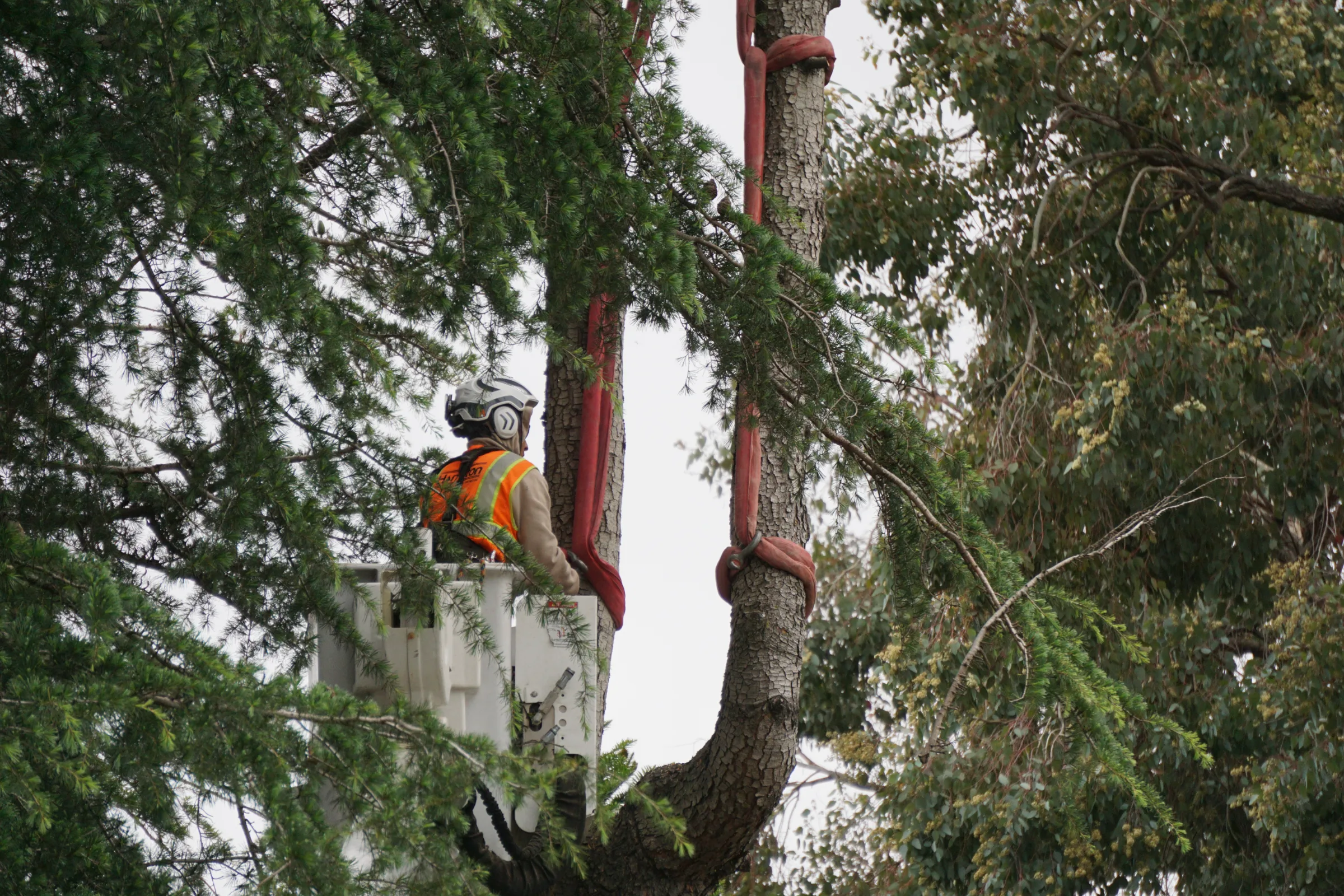
Pruning is the work that decides what a tree becomes. Done on a young tree it sets the structure it will carry for decades. Done on a mature tree it removes what is dead, crossing, or heading somewhere it shouldn't — a roof, a service line, a neighbor's yard.
The most common request we get is hazard reduction: a limb over a bedroom, a leader that has split, deadwood over where the children play. That is targeted work, not a haircut. We take what needs to come out and leave the tree able to seal the wound.
Done properly, most of the work is at the outer canopy and the tree does not look as though much has happened to it. Over-pruning is what shows: a tree stripped of its inner limbs or its lower branches grows back fast and weakly, and needs doing again sooner.
We do not top trees. Topping produces weak regrowth that fails in the next storm and shortens the life of the tree, which is why it is not accepted practice.
What pruning includes
- Crown cleaning — dead, dying, diseased and weak limbs, and watersprouts
- Crown thinning for light, air movement and canopy weight
- Crown raising for clearance over drives, paths and roofs
- Crown reduction where the species can carry it, cut to proper points
- Hazard-reduction pruning on limbs over structures
- Weight reduction on heavy limbs, and thinning to cut wind load
- Structural pruning on young trees to set future form
- Cuts made at the branch collar so the tree can compartmentalize
Pruning: common questions
- When is the best time to prune?
- For most species here, the dormant season gives the cleanest result and the least stress on the tree. Deadwood and genuine hazards are the exception — those come out whenever they are found, because the risk does not wait for a season.
- What standard do you prune to?
- ANSI A300, the American national standard for tree care, which is where the names above come from. It matters because it makes a job checkable: crown cleaning, thinning, raising and reduction mean the same thing to us, to whoever writes the specification and to whoever inspects the work afterwards.
- How much can be taken off at once?
- Less than most people expect. Removing too much live canopy in one visit starves the tree and triggers weak, fast regrowth — which is why stripping out the inner limbs and cutting off all the low branches are the two most common ways a tree is damaged by pruning. Where a tree needs a lot of work, we stage it across visits.
- Can pruning save a tree that has been called hazardous?
- Often. A hazard is a tree and a target together — the same dead limb reads differently over a play area than over an empty corner of the lot — so the question is whether the risk can be brought down to something the owner is willing to live with. Taking weight off the heavy limbs and thinning the canopy so it catches less wind does it in a lot of cases, and on a large mature tree that nobody will see replaced in their lifetime it is worth trying before removal. Where it will not be enough, we say so rather than prune it twice.
- Will you top my tree if I ask?
- No. Topping leaves large wounds the tree cannot seal and produces regrowth that is weakly attached and prone to failure. If the goal is a smaller tree, we will talk through crown reduction done at proper cut points, or removal and replanting with something the right size for the space.
Which trees need a permit in 22 Bay Area cities and counties, and where to apply.
Related services
- Tree health care
Drought response, fertilizing, soil work, and pest and disease management.
- Arborist consulting & reports
Written arborist reports and consulting for planning, permits and disputes.
- Tree management programs
Ongoing management for HOAs, municipalities, government, corporate campuses, golf courses and parks.
- Fire prevention & fuels reduction
Defensible-space and fuels-reduction clearing on residential and commercial parcels.
Our sister companies
Two companies behind the work: one turns what we cut into mulch, the other keeps our trucks and equipment running.
Produces our mulch
EcoMulch
Makes mulch from local tree work, ours included, and sells it with soil, compost and rock, for pickup in Martinez or delivery to your driveway.
Visit ecomulch.org (opens in a new tab)Maintains and repairs our fleet
Rex Mechanical
Heavy equipment repair, welding, hydraulics and fabrication, in its shop in Concord or on site across Northern California.
Visit rex-mechanical.com (opens in a new tab)
Talk to someone about your pruning
Estimates are free. Tell us what you’re looking at and we’ll come and have a look.