

Defensible space and fuels-reduction clearing
Defensible-space and fuels-reduction clearing on residential and commercial parcels.
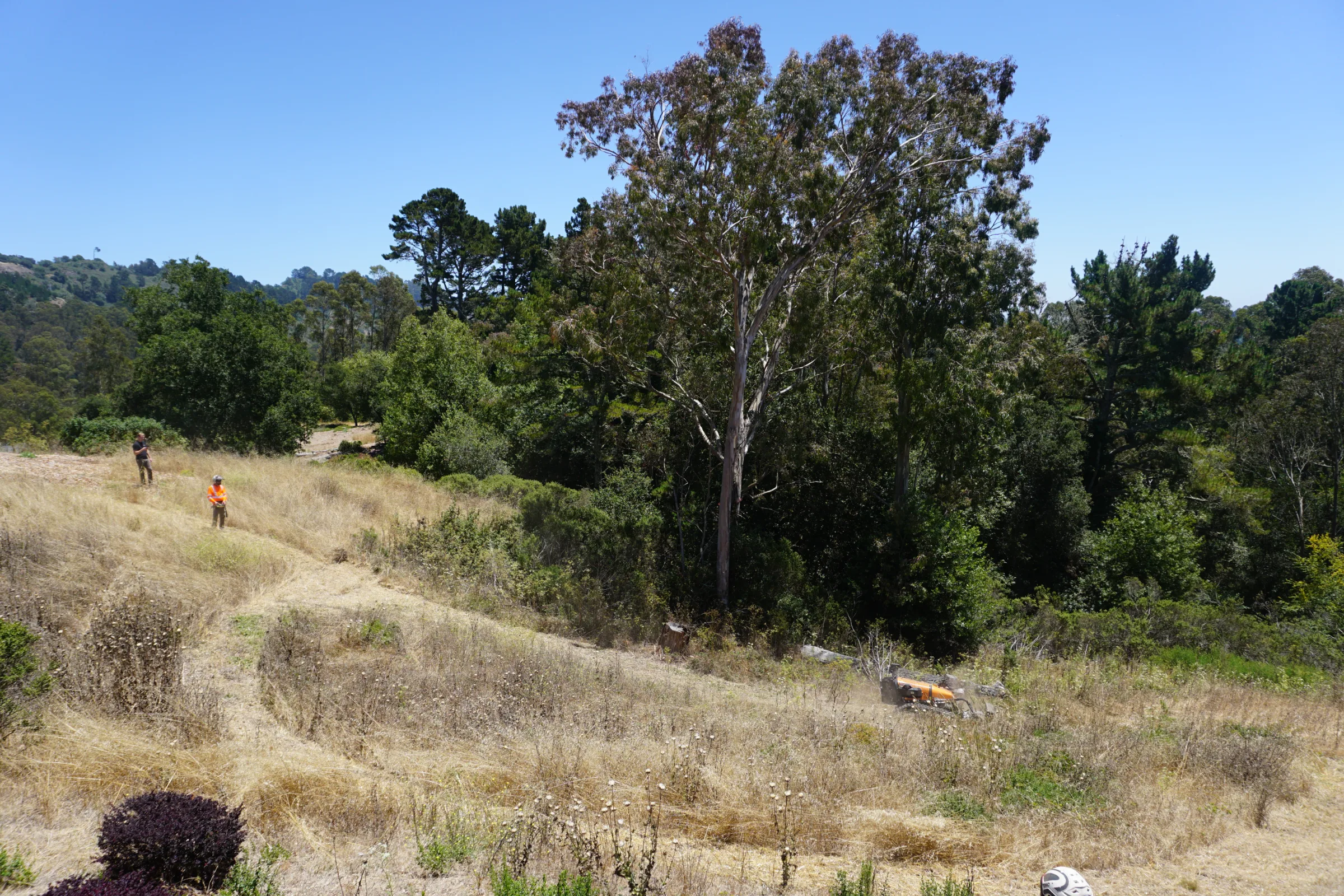
Fuels reduction is about breaking the path a fire uses to climb. Surface brush carries fire to low limbs, low limbs carry it into the canopy, and a continuous canopy carries it across a property.
Defensible space is the same idea measured out from a building: 100 feet, or as far as the property line where that comes first, treated in zones that get stricter the closer they are to the house. It is what slows a fire before it arrives, and it is also what lets a crew stand and defend the place instead of driving past it.
In practice that means clearing brush and dead material near structures, limbing up so there is separation between the ground and the canopy, thinning where crowns are touching, and taking out standing dead wood.
The volume that comes off this work is significant, which is where our grinding equipment matters — the material is processed rather than piled and left, because a pile of cut brush is fuel too.
What fire prevention & fuels reduction includes
- Brush and surface-fuel clearing in the zones around structures
- Limbing up to break the ladder between ground and canopy
- Crown thinning and separation where canopies are continuous
- Removal of standing dead and dying trees
- Grass and weed abatement cut to the local district's standard
- Clearance around wood piles, propane tanks and outbuildings
- Roadway and driveway clearance where the district asks for it
- Grinding and haul-off of everything cut
Fire prevention & fuels reduction: common questions
- How far out from the house has to be cleared?
- A hundred feet, or to the property line where that comes first, and it is not all treated the same. Five to thirty feet is the lean-and-green zone: dead plants, leaves and needles gone, ten feet kept between tree branches, nothing that burns left sitting against the wall, and anything overhanging the chimney cut back. Thirty to a hundred feet is the reduce-fuel zone: grass cut down, spacing opened up between what is left standing, and fallen litter kept to about three inches deep.
- What about the first five feet?
- That is the ember-resistant zone, and as of September 2026 it is recommended rather than required — it is written into the statute, but the regulation that would switch it on has not taken effect. It is still the most valuable five feet on the property, because embers landing against a wall are what starts most houses burning. In practice it means no bark mulch, no firewood stacked against the siding and nothing combustible in that strip. Moraga and Orinda are the exception: their fire district already writes the zone into its own ordinance.
- Who enforces this, and to what standard?
- Your local fire district rather than CAL FIRE, because this is a Local Responsibility Area. Martinez and most of central Contra Costa answer to the Contra Costa County Fire Protection District; Moraga and Orinda to the Moraga-Orinda Fire District. Both hold a tighter line than the state minimum and put a date on it — grass and weeds to no more than three inches rather than the state's four, limbs cleared six feet off the ground, and a central-county abatement deadline of June 1. Whether the full hundred-foot duty applies to your parcel turns on its hazard-severity zone, and those maps were redrawn in July 2025.
- How much space is needed between trees and shrubs?
- Vertically, branches come off to six feet from the ground, and where a shrub sits under a tree the gap between the top of the shrub and the lowest limb wants to be three times the shrub's height — a five-foot shrub needs fifteen feet. Horizontally it depends on the slope, because fire moves faster uphill: ten feet between tree canopies on flat ground, twenty on a moderate slope and thirty on a steep one, with shrubs spaced at two, four or six times their own height across the same bands.
- Does this mean removing all the trees?
- No, and it usually shouldn't. The aim is separation and removing what is dead — continuous fuel is the problem, not trees. A well-spaced, limbed-up stand of healthy trees is compatible with defensible space; a wall of untended brush is not.
- What happens to the cut material?
- It is ground and hauled out. Leaving cut brush piled on the property replaces a standing fuel problem with a stacked one, which is worse — cured, cut material ignites more readily than what it came from.
Which trees need a permit in 22 Bay Area cities and counties, and where to apply.
Related services
- Land clearing
Lot and parcel clearing, with large-scale wood grinding and haul-off.
- Pruning
Structural and maintenance pruning, plus hazard-reduction pruning on trees over structures.
- Tree management programs
Ongoing management for HOAs, municipalities, government, corporate campuses, golf courses and parks.
- Hauling & disposal
Log, chip and brush hauling, with green-waste recycling.
Our sister companies
Two companies behind the work: one turns what we cut into mulch, the other keeps our trucks and equipment running.
Produces our mulch
EcoMulch
Makes mulch from local tree work, ours included, and sells it with soil, compost and rock, for pickup in Martinez or delivery to your driveway.
Visit ecomulch.org (opens in a new tab)Maintains and repairs our fleet
Rex Mechanical
Heavy equipment repair, welding, hydraulics and fabrication, in its shop in Concord or on site across Northern California.
Visit rex-mechanical.com (opens in a new tab)
Talk to someone about your fire prevention & fuels reduction
Estimates are free. Tell us what you’re looking at and we’ll come and have a look.